

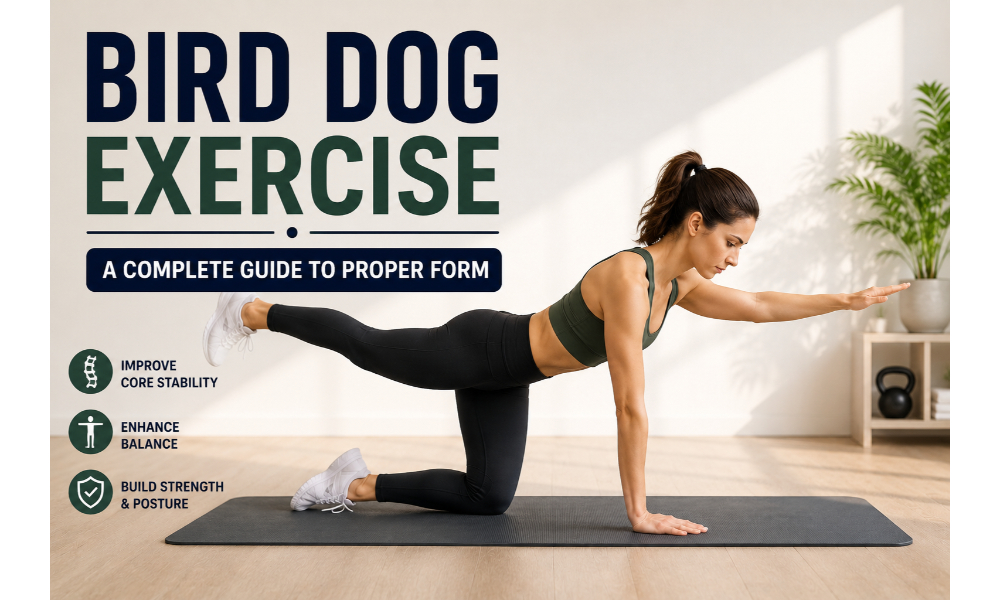
The bird dog is a simple, low-impact bodyweight exercise that’s a staple in core stability and back-strengthening routines across the United States, from physical therapy clinics to home workout programs. Despite how easy it looks, proper form is essential to getting the full benefit and avoiding strain. Here’s a complete breakdown of how to do the bird dog correctly, what it works, and how to progress it over time.
Key Takeaways
| ✔ Strengthens the core, lower back, glutes, and shoulders together
✔ A neutral spine and level hips are the key to correct form ✔ Widely used in physical therapy for low back pain and core stability ✔ Avoid arching the back, rushing reps, or letting the hips rotate ✔ Easy to scale up or down for any fitness level, no equipment needed |
What Is the Bird Dog Exercise?
The bird dog is a bodyweight exercise performed on the hands and knees, in which you extend one arm and the opposite leg at the same time while keeping the spine stable and neutral. Its name comes from the pointing stance of hunting dogs. Because it challenges balance and core control without putting stress on the joints, it’s widely used in fitness training, physical therapy, and rehabilitation programs for the lower back.
What Muscles Does the Bird Dog Exercise Work?
The bird dog is considered an anti-rotation and anti-extension core exercise, meaning it trains your core muscles to resist unwanted movement rather than create it. This makes it especially effective for building functional core strength.
▸ Transverse abdominis and rectus abdominis (deep and outer core muscles)
▸ Erector spinae (muscles that run along the spine)
▸ Glutes and hip stabilizers
▸ Shoulder stabilizers, including the rotator cuff muscles
▸ Multifidus muscles, which support spinal stability
How Do You Perform the Bird Dog Exercise With Proper Form?
Getting the form right is what separates an effective bird dog from one that offers little benefit. Follow these steps in order:
- Start on your hands and knees in a tabletop position, with wrists under shoulders and knees under hips
- Engage your core by gently pulling your belly button toward your spine
- Keep your neck in a neutral position, looking slightly down at the floor
- Slowly extend your right arm forward and your left leg backward at the same time
- Keep your hips and shoulders level and square to the floor — avoid tilting or rotating
- Hold the extended position briefly, then return to the starting position with control
- Repeat on the opposite side, alternating for the desired number of repetitions
Move slowly and with control rather than quickly swinging the arm and leg into place. The goal is stability, not momentum.
How Many Sets and Reps Should You Do?
The right volume depends on your fitness level and goals. The table below offers general starting guidelines that can be adjusted as you build strength and control.
| Fitness Level | Sets x Reps (each side) | Hold Time |
| Beginner | 2 x 8–10 | 1–2 seconds |
| Intermediate | 3 x 10–12 | 2–3 seconds |
| Advanced | 3–4 x 12–15 | 3–5 seconds |
| Rehab / Low-Impact | 2 x 5–8 | 1–2 seconds |
What Are Common Mistakes to Avoid?
Because the bird dog looks simple, it’s easy to perform with poor form that reduces its effectiveness or adds strain to the lower back.
▸ Arching or overextending the lower back instead of keeping the spine neutral
▸ Raising the arm or leg too high, causing the hips or shoulders to rotate
▸ Moving too fast and relying on momentum rather than muscle control
▸ Letting the head drop or crane upward instead of staying in a neutral position
▸ Holding your breath instead of breathing steadily throughout the movement
What Are the Benefits of the Bird Dog Exercise?
The bird dog offers several evidence-backed benefits, which is part of why it’s so widely recommended by trainers and physical therapists.
▸ Builds core strength and stability without loading the spine
▸ Improves balance and coordination between opposite limbs
▸ Supports better posture by strengthening postural muscles
▸ May help reduce or prevent low back pain when done consistently
▸ Requires no equipment, making it easy to do anywhere
▸ Suitable for a wide range of fitness levels, including rehab settings
How Can You Modify the Bird Dog Exercise for Different Fitness Levels?
The bird dog can be scaled up or down depending on your current strength and stability.
For beginners
Practice moving just the arm or just the leg at a time before combining both, and keep repetitions low while focusing entirely on form.
For a greater challenge
Add a resistance band around the hands and feet, hold each extended position longer, or incorporate a light dumbbell or ankle weight once form is fully mastered.
For rehabilitation
Work with a physical therapist to determine an appropriate range of motion and repetition count, especially if you have an existing back injury or condition.
Frequently Asked Questions
Q: Is the bird dog exercise good for lower back pain?
A: Yes, the bird dog is commonly recommended in physical therapy for building core and back stability, which may help reduce low back pain when performed with proper form and consistency.
Q: How often should you do the bird dog exercise?
A: Most people can safely perform the bird dog 2 to 4 times per week as part of a core or full-body routine, though a physical therapist may recommend daily practice for rehabilitation purposes.
Q: Can beginners do the bird dog exercise?
A: Yes, the bird dog is considered a beginner-friendly exercise since it uses only body weight and can be modified by reducing range of motion or holding time.
Q: What’s the difference between the bird dog and the superman exercise?
A: The superman is performed lying face down and extending both arms and legs at once, while the bird dog is done on hands and knees and typically moves one arm and the opposite leg at a time, offering more balance and core control training.
Q: Should you feel the bird dog exercise in your lower back?
A: You may feel gentle engagement in your lower back muscles, but sharp pain or excessive arching usually signals a form issue, and the movement should be adjusted or stopped.
The bird dog is a small movement with a big payoff when done correctly. By focusing on a neutral spine, slow controlled motion, and level hips, you can turn this simple exercise into an effective tool for core strength, better posture, and a healthier back.
